• Home
  • About Vista Farm
  • Plants
  • Birds
  • Insects
  • Fish, Mammals and More at Vista Farm
  • Native Plants of Louisiana
  • Contact
Don't Kill My WeedsDon't Kill My Weeds
  • Home
  • About Vista Farm
  • Plants
  • Birds
  • Insects
  • Fish, Mammals and More at Vista Farm
  • Native Plants of Louisiana
  • Contact

Counting Caterpillars

Home AnimalsCounting Caterpillars
Black Swallowtail
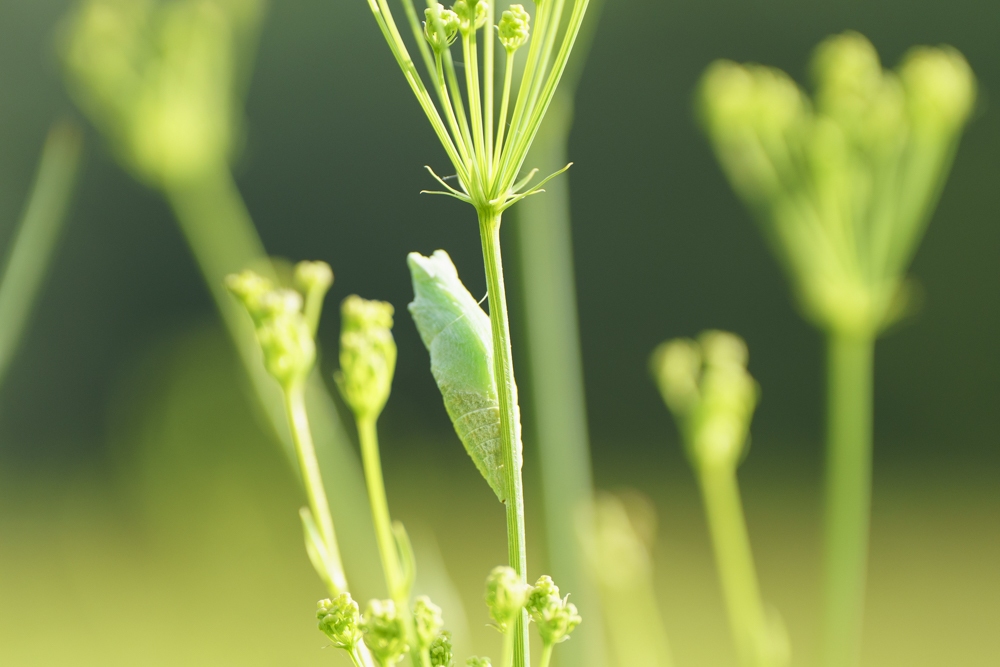
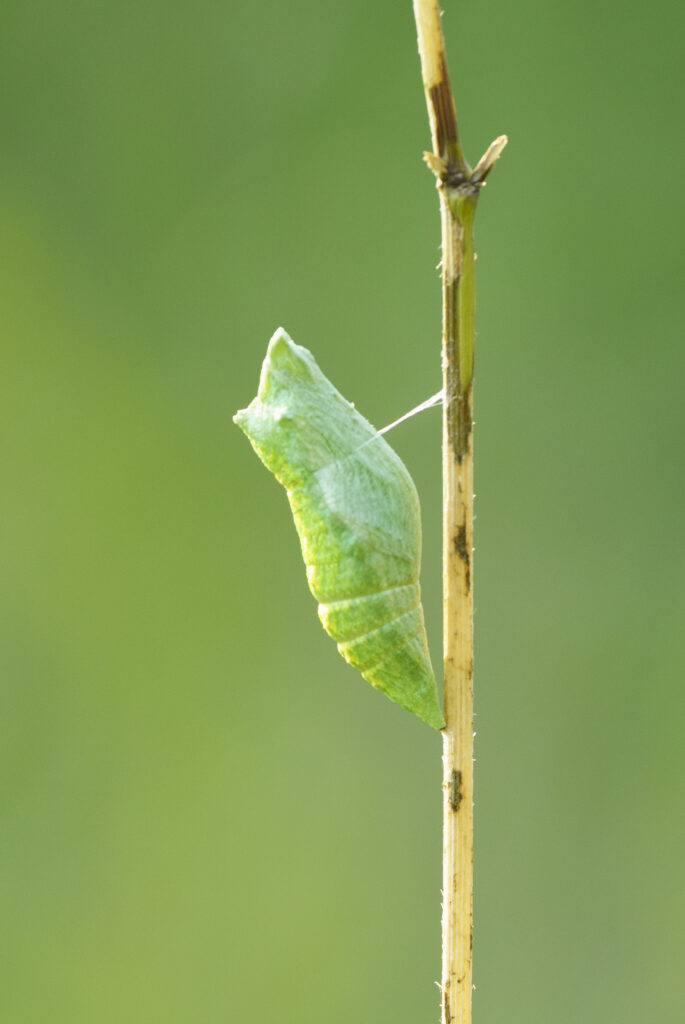
A Black Swallowtail cocoon just formed on a stem of Water Cowbane.

Counting Caterpillars

October 15, 2024 Posted by Judy Darby Animals, Biodiversity, Butterflies, Ecology, Ecosystem, Environment, Gardening, Habitat, Insects, Native Lousiana Species, Native Wildflowers, NRCS, Plants, Pollinators, Wildflowers, Wildlife

We have a special affinity for large, beautiful swallowtails and want to see their population thrive. When we acquired Vista Farm in 2005 there were six acres of open, flatwood meadows with grasses and wildflowers that serve as hosts to many moths and butterflies. In the middle of July the meadows are thick with Water Cowbane, Oxypolis filiformis, a tall member of the carrot family, that produces clusters of tiny white flowers atop a slim, bare stalk. This species is a host to the Black Swallowtails we enjoy every year. Last Fall with assistance from the Natural Resources Conservation Service’s stewardship program, we added 39 new native wildflower species, to a two-acre patch on the west side of the property. The mix included two species of plants on which swallowtail butterflies lay their eggs and feed on the tender flowerheads until they form the chrysalis in which they pupate. Knowing that there would not be much in the way of blossoms until the new seeds become established in two or three years, we decided to begin a study on whether the new hosts would improve the population of caterpillars and how many of them would ultimately become adult butterflies. On July 18, 2024, we began counting the caterpillars and chrysalises as soon as enough Water Cowbane came into bloom. A Black Swallowtail can lay 30-50 eggs per day and 200-400 eggs in a season. They hatch in 4-10 days.
Black Swallowtail

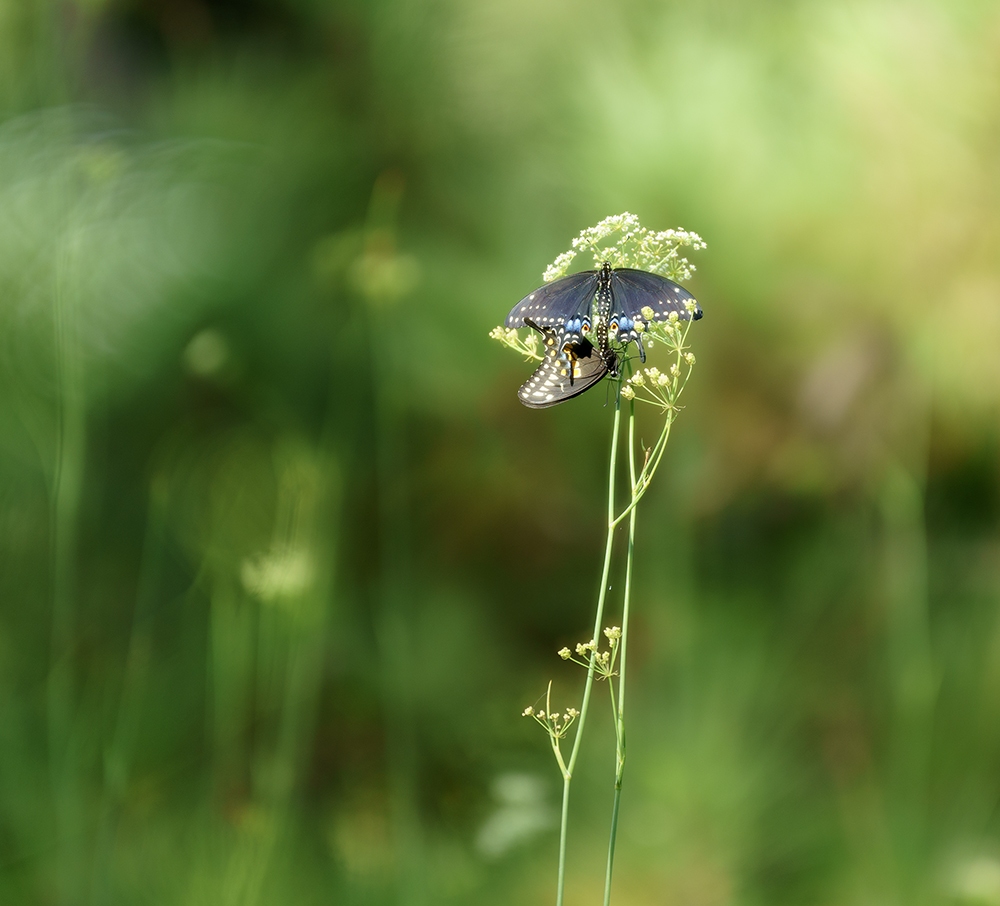
A pair of Black Swallowtail butterflies at Vista Farm feeding on Water Cowbane.

Water Cowbane, Oxypolis filiformis, Host to Black Swallowtail

Family: Apiaceae (Carrot, fennel, celery or parsley family)
Native range: Southeastern United States, west to Texas, to south Florida; Bahamas and Cuba.
Hardiness zones: 8A–10B
Lifespan: Perennial
Soil: Wet to moist; moderately well-drained to poorly drained sandy or limestone soils, without a lot of organic matter.
Exposure: Full sun
Growth habit: Herbaceous, erect up to about 6 feet tall
Propagation: Seed

Some native Cowbanes are extremely toxic. The filiformis species is not believed to be so.

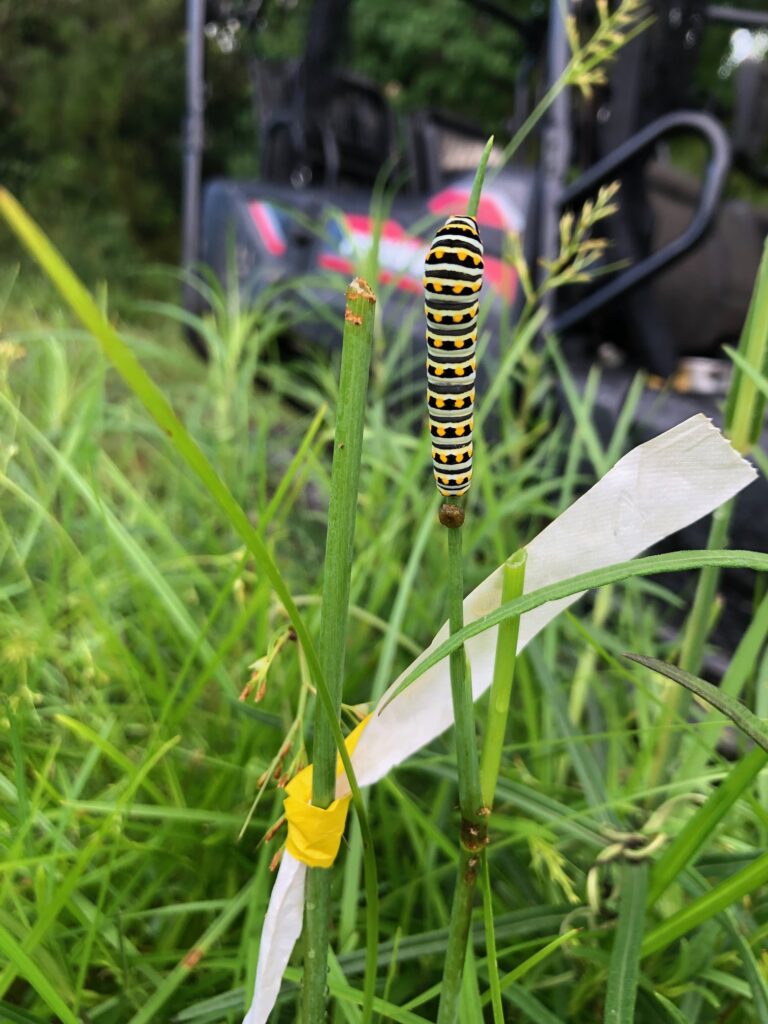
A Black Swallowtail Butterfly in its larval stage feeding on a stem of Water Cowbane. The tag marks the location of a caterpillar in the six acre meadow.
Black Swallowtail

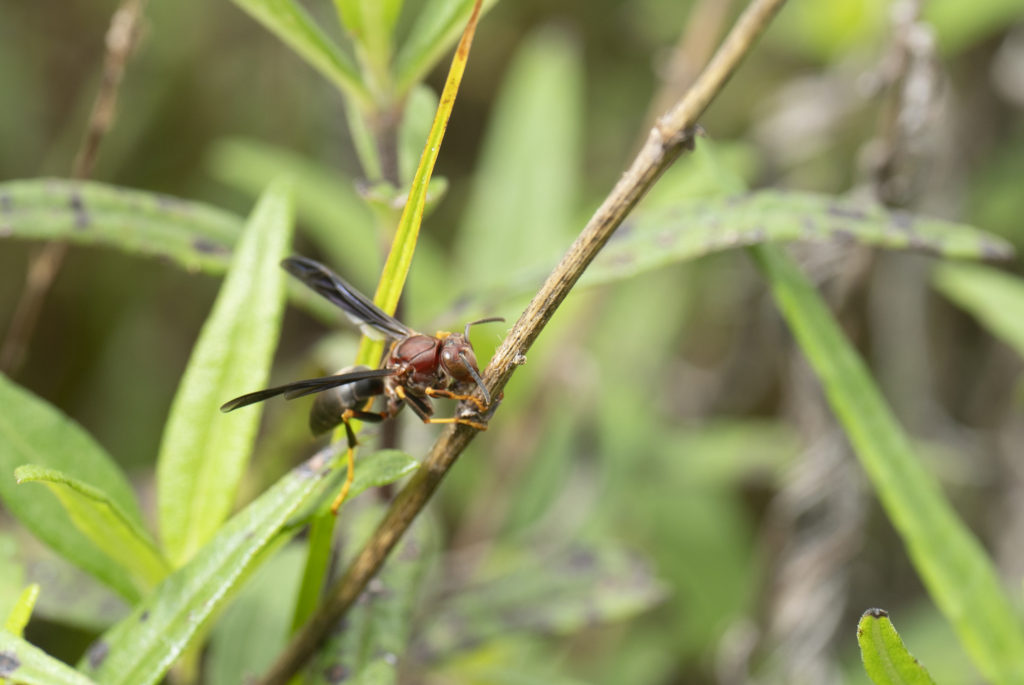
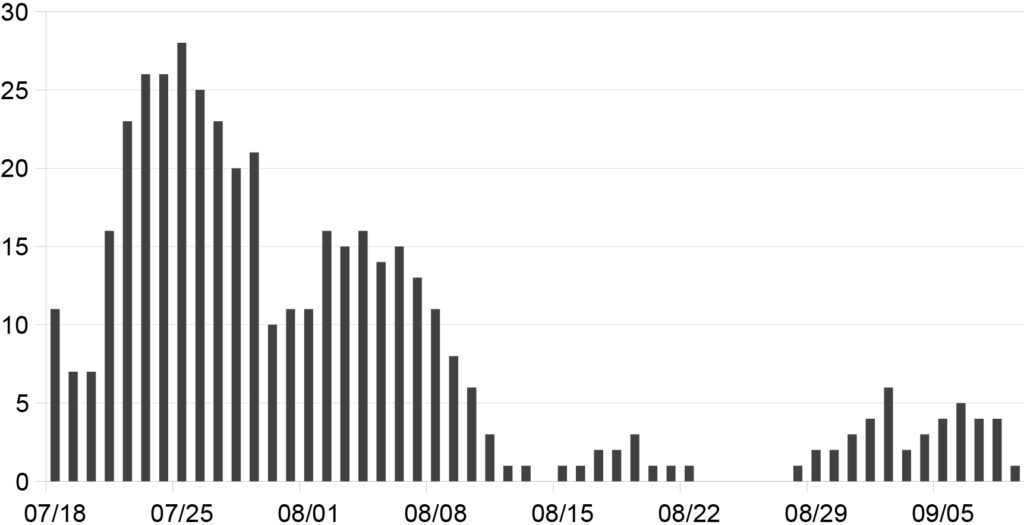
We used our well-worn paths through the meadow and cut a couple of new ones so as to find as many caterpillars as possible within the whole six acre meadow. On each stem where a caterpillar was feeding we tied yellow tape and returned each day to recount, adding or removing a tag as needed. As the season progressed we were surprised by a few things. First, the red Metric Paper Wasp, of which we have many, seems to love swallowtail caterpillars and will even eat any remains left on the chrysalis after the butterfly is gone. Predators don’t seem to care whether the caterpillar is a day old or fully formed, they will eat it. Second, we were disappointed that we could only find three chrysalises and the most caterpillars at one time was on July 25 when we had 28 tags. Third, after a caterpillar reaches its full size it stops eating and climbs down the stalk a bit where it finds a spot and ties itself to the stalk with a single silk thread. There it sits for up to about 24 hours until it decides to form the chrysalis. We do not know why it waits, but it’s time that allows a predator to attack. Is it sunlight or temperature; is it digesting and doing something internally that causes it to wait? One evening after tagging a dozen large caterpillars, we returned the next day to find them all gone. Did they move to another location to pupate (we saw a Black Swallowtail attached to a segment of Virginia Creeper vine on a fence adjacent to a busy street with no host in sight), or were they attacked? Even keeping a close watch on those which were tied to their stems, we did not see a single caterpillar begin to form its chrysalis. Having watched a Metric Paper wasp attack a fully developed caterpillar, we tend to think it’s predation. There are many, many caterpillar-eating animals on Vista Farm. The meadow is a healthy ecosystem with a huge food chain.
Metric Paper Wasp

A male Metric Paper Wasp. Females have a yellow head.

Although there was a good number of at least four species of swallowtails (link is to iNaturalist observations) flying about and feeding on Cowbane all summer, Black Swallowtails only lay their eggs on plants in the carrot family. Additional swallowtail hosts somewhere in proximity have not been identified.

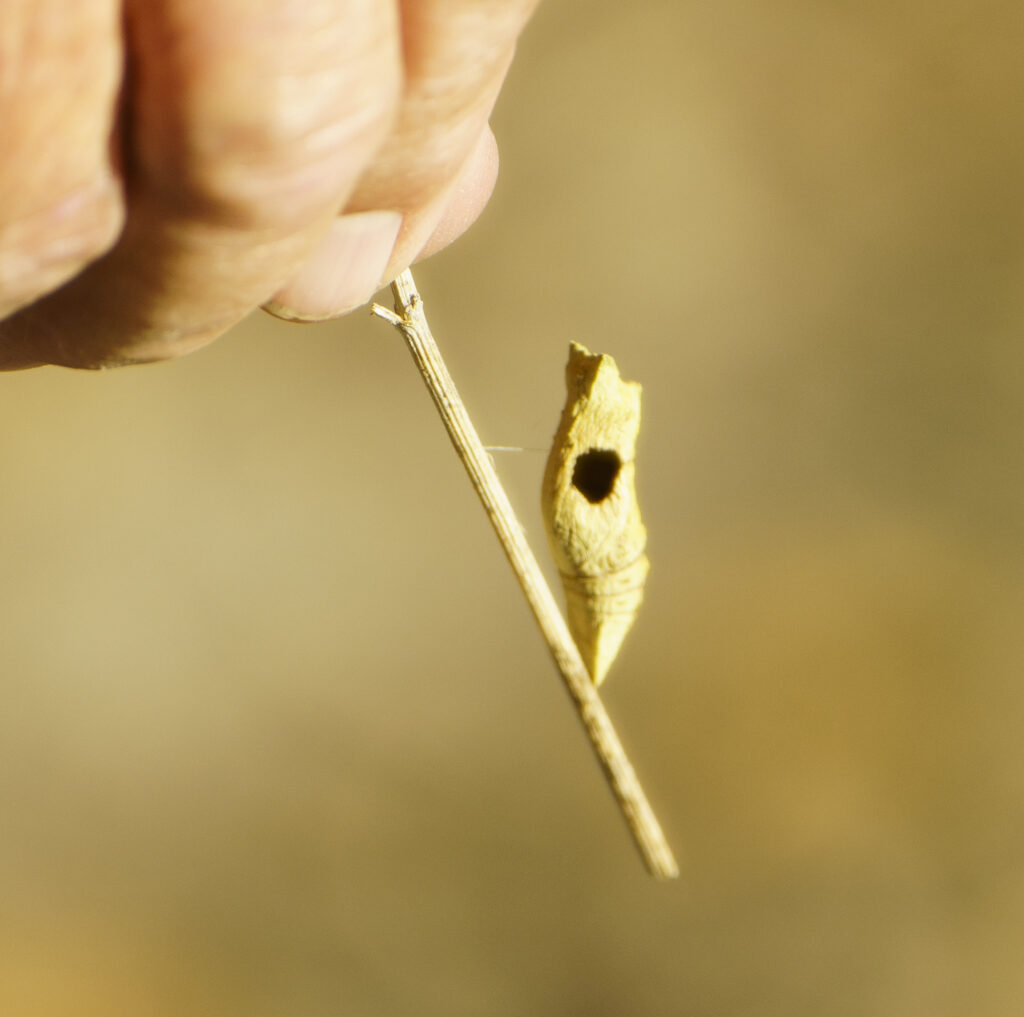
The butterfly count is graphed below. It shows the population each day as the Cowbane season progressed. Over 54 days the total number of caterpillars tagged was 437. It was 10 days from the first tagged caterpillar to the first chrysalis and only three chrysalises were tagged during the whole 54 days. The first butterfly left the chrysalis after exactly 10 days; the second after 13 days and the third was found with a perfectly round hole in the side.
Cocoon with a hole
A Black Swallowtail chrysalis with a hole in the side.

There was a precipitous drop in the population after August 8. This drop coincided with the Cowbane beginning to form seed at the top of the flowerhead. By late August the few caterpillars that hatched had only limited flowers to feed upon and had to get by on the tough fibrous outer layer of the stem, or in some cases the stem itself. In September we observed them eating the tender green seed cases forming in clusters at the top of the stems.
Black Swallowtail
Black Swallowtail chrysalis

To Protect or Not to Protect

We contemplated taking some of the caterpillars after they tied themselves to the stem and putting them in a safe place to pupate. On the other hand, wasps and bees play a big role in pollinating our meadow and are just trying to make a living for themselves by eating our caterpillars. To protect or let Nature take its course is the dilemma.

On the 9th day of September we observed the last caterpillar in the meadow. It had tied itself to an almost bare stem and was doing whatever caterpillars do to prepare themselves for pupating. It was late afternoon and realizing there was little chance of it surviving, we cut the stem and put the little caterpillar in a large glass jar with netting over the top. We put it in a safe place where it survived a tropical storm two days later. On September 17 as we were about to leave for a funeral I thought about the caterpillar and decided to remove the net in case it hatched. Inside the jar, a new Black Swallowtail was just emerging and opening its wings.
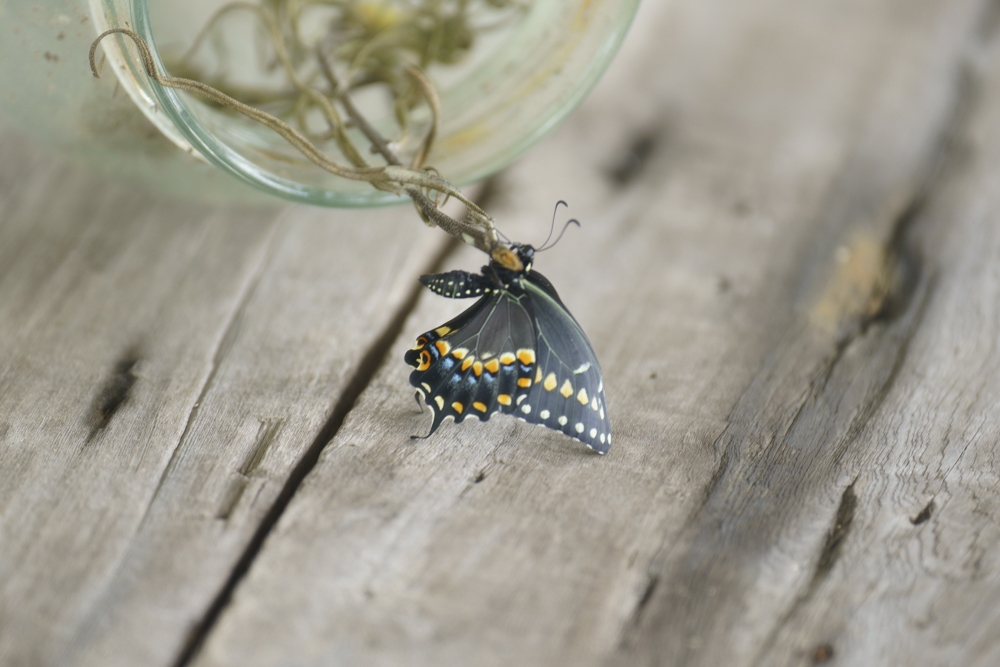
Black Swallowtail, Papilio polyxenes

I cut the net and pulled out the stem with the butterfly still attached. Twenty-four hours later we returned. The swallowtail was gone and the stem was exactly where we left it. There are plenty of flowers in the area so I’m confident it is somewhere out there happily looking for a mate.
Tags: biodiversityButterflieschrysalisCocoonecologyecosystemflatwoodhabitatLouisianaMadisonvilleMetric Paper WaspOxypolispupaeSwallowtailVista Farmwater cowbanewildlife
0
Share

About Judy Darby

Judy Darby is a photographer and freelance writer in Madisonville, Louisiana. Originally from Ruston, Louisiana, she lived in Weston, Connecticut for more than 20 years before moving to south Louisiana where she met her long-time significant other, Noel Brumfield, a U.S. Coast Guard licensed 100-ton captain. Judy exchanged a 15-acre tract on Interstate 20 in Ruston for Vista Farm in 2005 and is turning it into a protected habitat for small wildlife and native plants.

You also might be interested in

Meadow American Bumble Bee
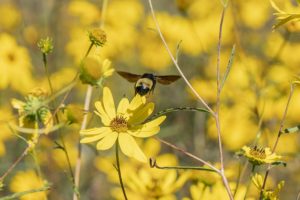
Meadow American Bumble Bee, Bombus pensylvanicus, busily pollinating the sunflowers at Vista Farm. is a threatened species of bumblebee native to North America. Its tends to live and nest in open farmland and fields feeding on several food plants, but favoring sunflowers and clovers. While bees normally forage close to their nests, individuals can return from up to 1.5 miles away. Bombus pensylvanicus generally nests in fields of long grass, but may sometimes nest underground. The species utilizes bundles of hay or long grass to create sheltered nests above ground. Some nest in established crevices and burrows, such as old bird nests, rodent burrows, or in cinder blocks. They have even been noted to nest in human made objects, like buckets or barns. Assassin bugs and dragonflies are common predators of the bee. Queens are considered the dominant caste because they are usually the largest bees of the colony. As worker male bees grow larger in average wing length, they become the dominant caste as the number of queens decrease. Wing length of males vary depending upon the point of colony development. Males that founded the colony tend to have a smaller wing length than the first or second generation of the colony. Food supply is scarce, at first, as the queen is the forager. Until July, the workers are the foraging caste and an enormous increase in body size is observed. The worker proportions decrease when reproductive males develop, representing a turning point in the colony, as male size increase until active bees develop to the size of a queen near November and December when the worker population dissipates. Queens maintain the least amount of standard deviation for average wing length and thus are the most stable caste in the colony. It is postulated that this is because queens are made in a short time span when colony resources have reached its threshold. Source Wikipedia

Building An All-Native Wildflower Habitat

Oct 14, 2023

Building a new pollinator habitat of all native wildflowers with funding from the NRCS Conservation Stewardship Program.

Savanna Sneezeweed
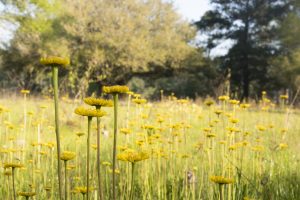
A field of Savanna Sneezeweed, Helenium vernale, growing in the meadow with live oak, pine, grasses, and crawfish.

The Ecosystems at Vista Farm, a Small-Wildlife Habitat

Aug 8, 2019

Vista Farm is a thirty-acre tract of flatwood (pine savanna)[...]

White Tail Deer
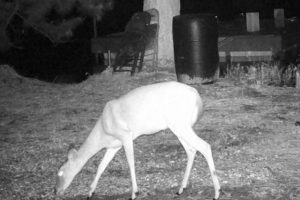
White Tail Deer grazing at the pond at night.

Caught on Camera

May 28, 2021

Ever wonder what happens when your not there? Set up[...]

Recent Posts

  • 2026 Vista Farm Journal
  • Fish Pond Management
  • Duck Gumbo with Andouille Sausage
  • 2025 Journal
  • Counting Caterpillars

Recent Comments

    Archives

    • January 2026
    • December 2025
    • November 2025
    • January 2025
    • October 2024
    • June 2024
    • April 2024
    • January 2024
    • October 2023
    • August 2023
    • January 2023
    • April 2022
    • January 2022
    • September 2021
    • May 2021
    • April 2021
    • March 2021
    • January 2021
    • December 2020
    • November 2020
    • June 2020
    • February 2020
    • October 2019
    • September 2019
    • August 2019

    Categories

    • Advice
    • Animals
    • Biodiversity
    • Bird Migration
    • Birds
    • Butterflies
    • Carbon
    • Climate
    • composting
    • Ecology
    • Ecosystem
    • Environment
    • Fish
    • Fish Pond Management
    • Fishing pier
    • Floating boat dock
    • Gardening
    • Grasses
    • Habitat
    • Health
    • Insects
    • Journal
    • Muscovy
    • Muscovy Duck
    • Native Lousiana Species
    • Native Wildflowers
    • NRCS
    • Nutrition
    • Plants
    • Pollinators
    • Recipes
    • Recycle
    • Travel and Tourism
    • Trees
    • Uncategorized
    • Video
    • Weather
    • Wildflowers
    • Wildlife

    Most Commented Posts

    • The Ecosystems at Vista Farm, a Small-Wildlife Habitat By Judy Darby on August 8, 2019 0
    • Dirt and Germs! By Judy Darby on August 12, 2019 0
    • Vista Farm, A 30-acre Protected Flatwood By Judy Darby on August 13, 2019 0

    Recent Comments

    Most Liked Posts

    • Loblolly or Slash–Which Pine Is It? By Judy Darby on September 7, 2019 13
    • Native Louisiana Plants at Vista Farm By Judy Darby on June 8, 2020 2
    • How To Set up A Wood Duck Nest Box By Judy Darby on March 8, 2021 2

    Tag Cloud

    advice animal animals biodiversity bird birds Cocoon common name conservation duck ducklings ecology ecosystem environment flatwood forest gardening habitat hen how-to how to identification Louisiana Madisonville meadow Muscovy native native plants native species natural resources nest NRCS plants pond recycle small wildlife species tree Vista Farm Weather wetland wild wildflower wildflowers wildlife

    Contact Me

    I'll get back to you right away.

    Send Message

    A Monarch Butterfly laying an egg

    https://dontkillmyweeds.com/wp-content/uploads/2021/04/MAH05099.mp4

    Contact Info

    • Judy Darby
    • Darby Holdings, LLC
    • 810 Main St., Madisonville, LA 70447
    • judy@dontkillmyweeds.com
    • dontkillmyweeds.com

    Flickr Photostream

    © 2026 — Judy Darby

    • Home
    • About Vista Farm
    • Plants
    • Birds
    • Insects
    • Fish, Mammals and More at Vista Farm
    • Native Plants of Louisiana
    • Contact
    Prev Next